CE & ISO Certified Orthopedic Implants & Surgical Instrumentation
Engineered for absolute dimensional repeatability, bio-compatibility, and rigid mechanical performance across trauma, spine, sports medicine, joint, and veterinary surgical applications.
Navigating the Spanish Orthopedic Ecosystem: EU MDR Compliance & Quality Imperatives
Spain represents one of Europe's most rigorous and rapidly evolving markets for orthopedic medical devices. Distributed across autonomous communities—including healthcare procurement hubs in Catalonia (CatSalut), Madrid (SERMAS), Andalusia (SAS), and Valencia—the Spanish National Health System (Sistema Nacional de Salud - SNS) alongside leading private hospital groups (such as Quirónsalud, Vithas, and Sanitas) demand uncompromising product safety, full biological evaluation, and streamlined regulatory documentation.
Under the mandate of the Agencia Española de Medicamentos y Productos Sanitarios (AEMPS) and the European Medical Device Regulation (EU MDR 2017/745), medical device importers, distributors, and hospital purchasing groups in Spain can no longer tolerate supply chain ambiguities or incomplete technical files. Acquiring Class IIa, Class IIb, and Class III implants requires direct partnership with manufacturing factories operating under a fully audited Orthopedic Implant Quality Management System (QMS).
As a specialized OEM/ODM manufacturer and global export supplier, our facilities integrate ISO 13485:2016 quality management standards into every phase of production. From raw material bar stock verification to final cleanroom packaging, we supply Spanish orthopedic distributors with certified implants, matching surgical instruments, and complete technical dossiers (STED) engineered to accelerate AEMPS registration and hospital tender approval.
Architecture of Our Orthopedic Implant Quality Management System (QMS)
Quality in orthopedic manufacturing is not verified merely at final inspection; it is systematically engineered into every step of the machining workflow. Implant failures—whether due to fatigue micro-cracks, surface contamination, or dimensional mismatch with driver tips—carry devastating clinical consequences. Our QMS operates under strict risk management protocols aligned with ISO 14971.
Metallurgical & Raw Material Traceability
Every bar of Titanium Alloy (Ti-6Al-4V ELI grade according to ASTM F136 / ISO 5832-3), Stainless Steel (316L according to ASTM F138), and PEEK (ASTM F2026) undergoes incoming optical emission spectroscopy, ultrasonic flaw detection, and mechanical tensile testing before entering the shop floor.
5-Axis CNC Precision Machining
Utilizing high-precision Swiss-type automatic lathes and 5-axis simultaneous machining centers, we maintain tolerances within ±0.005mm. Variable-angle locking threads, cannulated cores, and complex anatomical curves are executed with absolute dimensional fidelity.
Passivation & Surface Finishing
Implants undergo automated ultrasonic cleaning, electro-polishing, nitric/citric acid passivation, and Type II/Type III color anodization. Surface roughness is strictly controlled ($Ra < 0.4 \mu m$) to optimize biocompatibility and reduce bacterial adhesion.
Comprehensive Product Systems Serving Spanish Hospitals & Surgical Centers
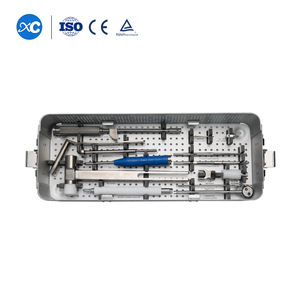
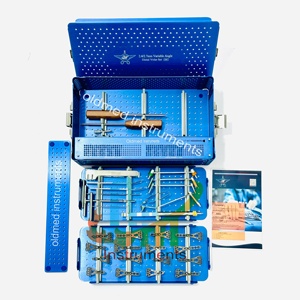
Distributors in Spain require a unified supplier capable of providing matched implant systems and surgical trays. Combining components from disparate factories creates surgical risks, such as loose hex-driver engagement or thread binding during intraoperative fixation. We manufacture complete, fully integrated product lines:
1. Spine Fixation & Interbody Systems
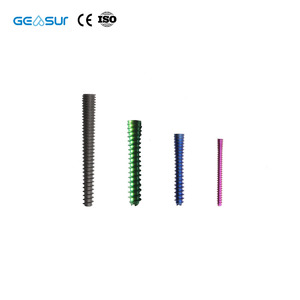
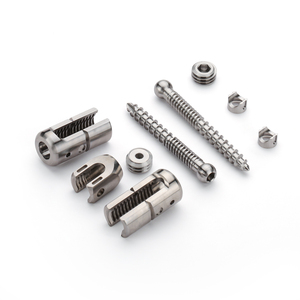
Designed for open and minimally invasive spine surgery (MIS). Our posterior thoracolumbar pedicle screw systems feature dual-lead thread geometries for rapid insertion and high pull-out strength in osteoporotic bone. Complemented by radiolucent PEEK lumbar interbody cages (TLIF, PLIF, ALIF) and low-profile cervical plate systems for degenerative spinal conditions.
2. Orthopedic Trauma & Intramedullary Nails
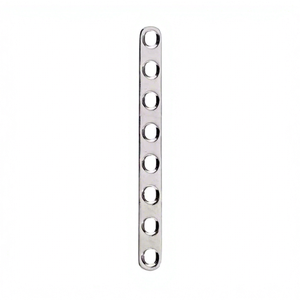
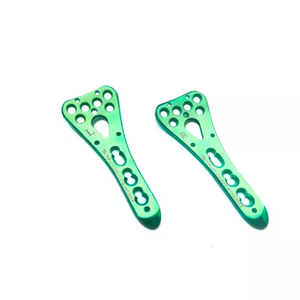
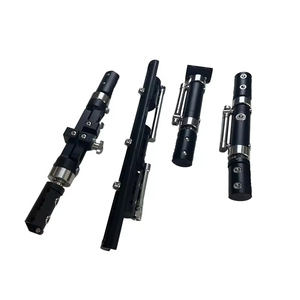
Featuring anatomical pre-contoured volar locking plates for distal radius fractures, proximal humerus reconstruction plates, and distal tibia systems. Our cannulated intramedullary nail portfolio (PFNA proximal femoral nails, tibial nails, femoral nails) includes magnetic-assisted or precision radiolucent aiming instrumentation for distal locking speed.
3. Sports Medicine & Arthroscopy
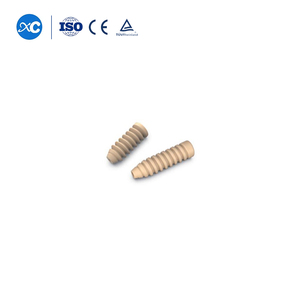
Addressing the booming sports traumatology demand across Spanish private clinics. Our portfolio includes bio-absorbable and radiolucent PEEK interference screws for ACL/PCL ligament reconstruction, metallic suture anchors, and cortical fixation buttons engineered for maximum pull-out resistance.
4. CMF & Maxillofacial Fixation
Ultra-low-profile 1.5mm, 2.0mm, and 2.4mm titanium micro and mini plate systems. Used in trauma reconstruction, orthognathic surgery, and cranial defect repair, offering superior malleability without sacrificing dynamic compression rigidity.
5. Joint Arthroplasty & External Fixation
Total Hip Replacement (THR) components incorporating Cobalt-Chromium-Molybdenum (CoCrMo ASTM F1537) femoral heads, highly cross-linked UHMWPE liners, and porous plasma-sprayed titanium stems. For complex trauma damage control, our modular unilateral and Ilizarov external fixators offer rapid stabilization.
6. Surgical Power Tools & Veterinary Systems
Autoclavable high-torque cannulated bone drills, oscillating saws, and reamers powered by brushless motors. Additionally, our dedicated veterinary orthopedic division supplies high-grade TPLO plates, total hip systems, and mini locking plates to veterinary surgical hospitals across Europe.
Material Science Standards & Biomechanical Specifications
To assist regulatory affairs personnel and procurement officers in Spain with technical file compilation, the table below outlines our primary implant material grades, testing standards, and targeted clinical indications:
| Material Designation | International Standard | Biomechanical Profile | Primary Clinical Application | AEMPS Regulatory Status |
|---|---|---|---|---|
| Ti-6Al-4V ELI Titanium Alloy | ASTM F136 / ISO 5832-3 | Yield Strength > 795 MPa; High fatigue endurance & low elastic modulus | Pedicle screws, locking plates, intramedullary nails, cannulated screws | Class IIb / Class III |
| Commercially Pure Titanium (CP Ti) | ASTM F67 / ISO 5832-2 | Superior ductility for intraoperative manual contouring | CMF micro/mini plates, titanium mesh, cranial reconstruction plates | Class IIb |
| Stainless Steel 316L | ASTM F138 / ISO 5832-1 | Cost-effective, high torsional stiffness, passivated oxide film | Trauma bone plates, Schanz pins, external fixation rods, instruments | Class IIa / Class IIb |
| PEEK Optima (Polyetheretherketone) | ASTM F2026 | Radiolucent, elastic modulus (3.6 GPa) closely matching human cortical bone | Interbody fusion cages, sports medicine interference screws | Class IIb / Class III |
| CoCrMo Alloy & UHMWPE | ASTM F1537 / ASTM F648 | Ultra-low friction coefficient, extreme wear resistance against joint fatigue | Arthroplasty femoral heads, acetabular cups, tibial bearings | Class III |
* Complete raw material mill test certificates (EN 10204 3.1), biocompatibility evaluation reports (ISO 10993 series), and dynamic fatigue test data (ISO 7206 / ASTM F1717) are provided with all OEM technical dossiers.
Streamlined OEM & Private-Label Partnering Process for Spain
We provide Spanish medical device companies and healthcare distributors with end-to-end contract manufacturing. Whether you require private-label laser marking on existing CE-marked catalog items or full contract development for proprietary surgical inventions, our structured six-stage workflow guarantees technical transparency and reliable delivery timelines.
Consultation
Technical review of product scope, CAD drawings, and target Spanish market volume.
Engineering
DFM (Design for Manufacturability) analysis & finite element stress simulation (FEA).
Prototypes
Rapid CNC prototyping and CMM dimensional inspection for surgeon approval.
Validation
Mechanical fatigue testing, bio-burden testing, and technical documentation assembly.
Mass Production
Automated 5-axis machining, color anodizing, and laser UDI code marking.
Spanish Delivery
ISO Class 7 cleanroom pouch sealing, customized Spanish labeling, and air shipping to Spain.
Enterprise Infrastructure, Quality Control Labs & Factory Capabilities
Operating a world-class Quality Management System demands continuous capital investment in manufacturing infrastructure and metrology equipment. Our production complex integrates state-of-the-art facilities designed to meet European healthcare standards:
Advanced Metrology Laboratory
Equipped with Zeiss 3D Coordinate Measuring Machines (CMM) with sub-micron accuracy, optical profile projectors, surface roughness testers, and digital video measuring systems to inspect 100% of complex geometries.
Cleanroom Packaging Environment
Final cleaning, ultrasonic degreasing, and primary packaging take place in a certified ISO Class 7 (Class 10,000) cleanroom environment. Dual Tyvek-pouch sealing ensures sterile barrier integrity post-gamma irradiation or ETO sterilization.
UDI Laser Etching & Traceability
Every single screw, plate, and instrument is etched with a high-resolution Unique Device Identification (UDI) matrix code. This enables complete digital lot traceability from hospital operating theater back to raw titanium ingot.
Frequently Asked Questions for Spanish Importers & Procurement Teams
Essential guidance on regulatory compliance, logistics, minimum orders, and customized manufacturing when importing orthopedic implants into Spain.
What documentation do you provide to support AEMPS registration in Spain?
How does your Quality Management System ensure zero-defect production for orthopedic screws and plates?
Can you supply private-label implants with custom Spanish language packaging?
What are the lead times for shipping orthopedic implant orders to major ports/airports in Spain?
Are your implant instruments compatible with existing surgical trays used in European hospitals?
Can Spanish distributors request evaluation samples prior to signing supply contracts?
Accelerate Your Orthopedic Supply Chain in Spain
Partner with an ISO 13485 certified manufacturer providing EU MDR compliant implants, transparent raw material traceability, and competitive factory-direct pricing for Spanish medical distributors and hospital networks.
Contact Us